Welcome
to the
Artist's Room of the Cultural Museum. Artists and works of artists
continues
with an international bronze sculpture.
Underwater Sculpture
Christ of the Deep
By Jerry Wilkinson
The approximate nine foot
bronze sculpture
symbolizes peace
of mankind from its unusual setting - beneath the ocean at Key Largo
Dry
Rocks off John Pennekamp Coral Reef State Park.
Below is the original casting being placed in the
Mediterranean
Sea at San Fruttuoso Bay (near Genoa, Italy) near Genoa, Italy in 1954.
It is known as the Il Christo Degli Abissi or in English - Christ of
the
Abyss.
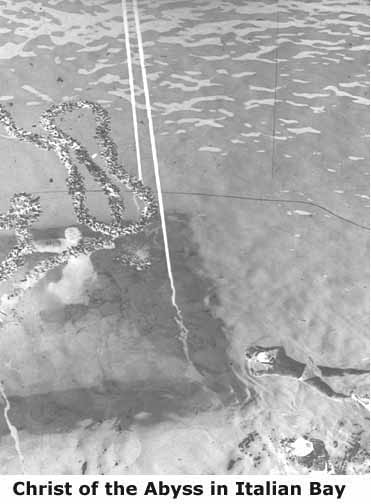
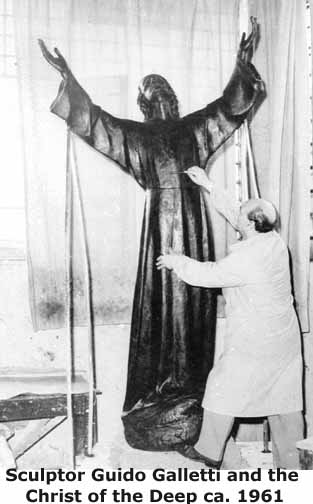
Professor Guido Galletti cast the original from the
inspiration
of Italian swimmer/diver Duilo Merchant who wanted a symbol to inspire
all who explored and loved the sea in 1954. In 1961, the second casting
from the original Galletti mold was placed in St. George's Harbor in
Grenada
to commemorate those saved from the Italian ship Bianca C.
which
caught fire and sank in the harbor. The third casting was commissioned
by Italian dive equipment manufacturer, Egidio Cressi, and donated
to The Underwater Society of America.
It was shipped to Chicago Illinois and arrived at the Navy
Pier.
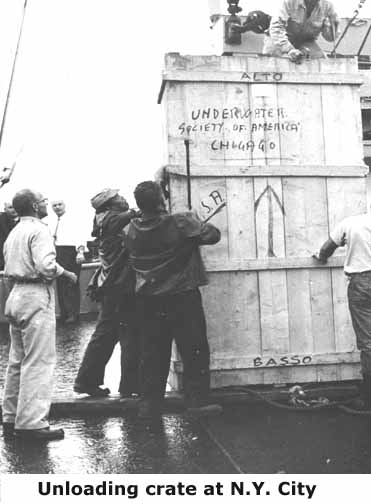
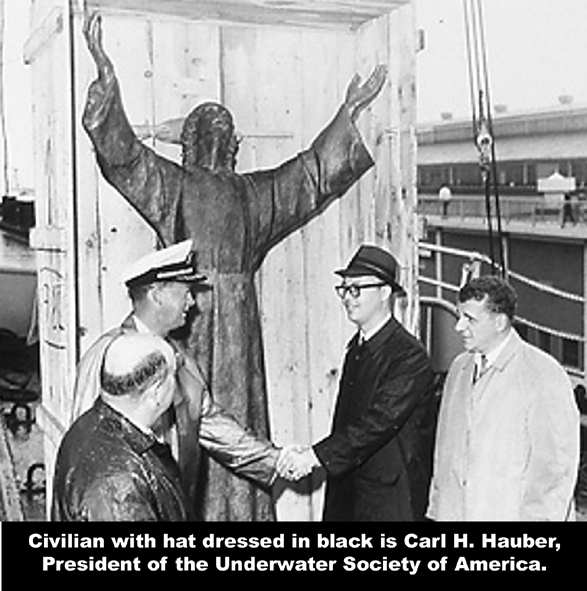
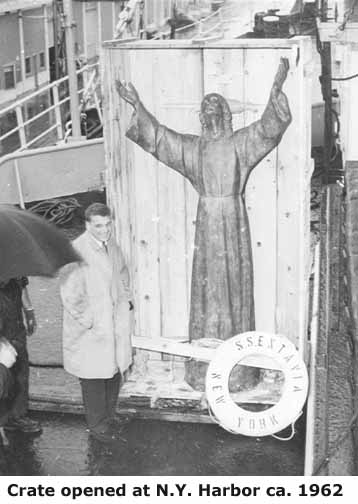
Above is shown the statue's arrival aboard the SS Extravia in a
wooden crate. Below is the opened crate with the receiving team of The Underwater
Society of America,
Carl Hauber, president.
Below is another photo at the opening of the shipping crate at
the Navy pier at Chicago.
Above
Gabe Spataro shown above and here as a member of the reception
committee.
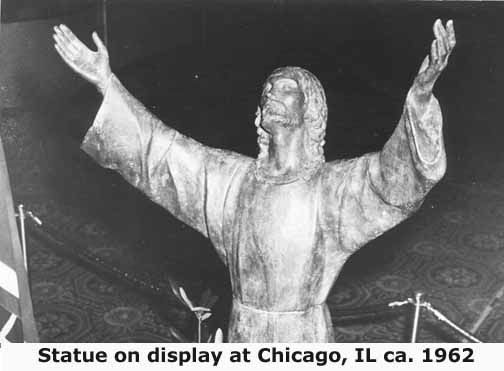
The display and celebration with a banquet and the
presentation to the United States
was held at the Palmer House in Chicago. After festivities
in Chicago, the statue was
shipped
and stored at O'Hare Airport. Finding a location for its permanent home
was not easy, but with the attention from Senator Spessard Holland of
Florida,
John Pennekamp Park won out, but there was no money to transport it to
Key Largo.
The Orlando, Florida Otter Diving Club took a lead and with
the
help of the Naval Reserve a training flight transported the statue to
Orlando, Florida
where it was displayed.

One problem which had to be overcome was why were we putting
this
beautiful statue under water where so few could see it. In January 1964
it continued it trip to the Florida Keys to the Art McKee museum on
Plantation Key. After engineering for the concrete foundation and other
preparations were finalized, the statue was sent to Pennekamp
Park in the spring of 1965.
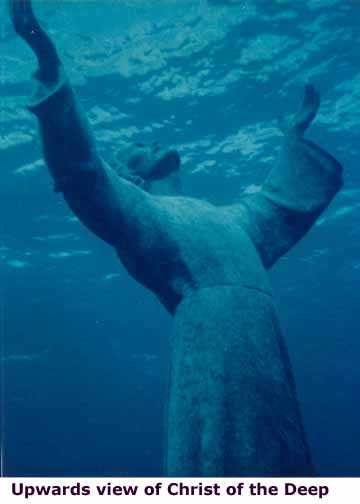
To prepare for a June placement, Park personnel poured the
huge
concrete base slabs. Weather and breakdowns prevented the use of state
equipment for actual placement.
Cothron Construction Co. of Islamorada was low bidder for the
two-day
placement which turned into three days. On August 25, 1965, the now
approximate
20,000 pound statue was lowered into the selected location.

It was dedicated on June 29, 1966 by John Pennekamp at Harry
Harris Park in Tavernier, but
before
this, it had to withstand a test. Hurricane Betsy provided this on
September
8, 1965 when she provided Category III wind churned seas and test its
placement. Despite many
doubting
Thomas', the statue stood firm and tall, and did not move.
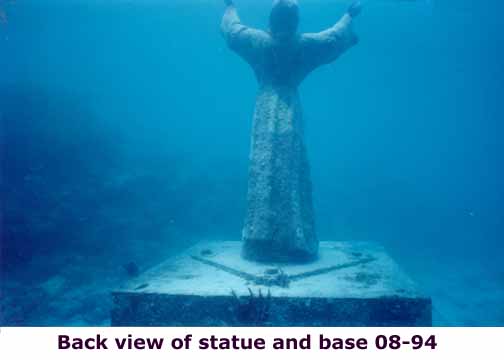
In 1994 Jerry Wilkinson of the Historical Preservation Society
nominated
the
statue for the Smithsonian Institute directed program of Save Outdoor
Sculpture
(SOS). He organized a survey team and these color photos are part of
the
result. Photos were taken by Richard Lemacks.
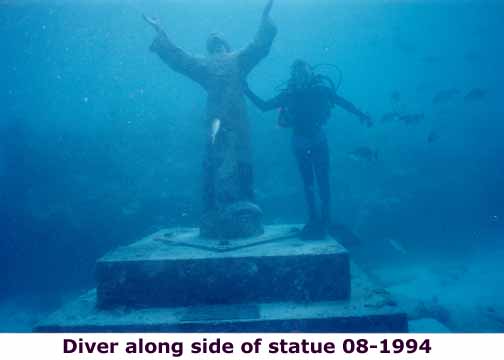
Team member, Tammy Swetman, stands beside the statue.
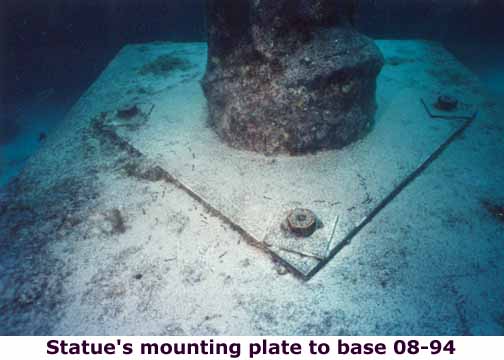
A close-up view of the mounting plate and attaching hardware.
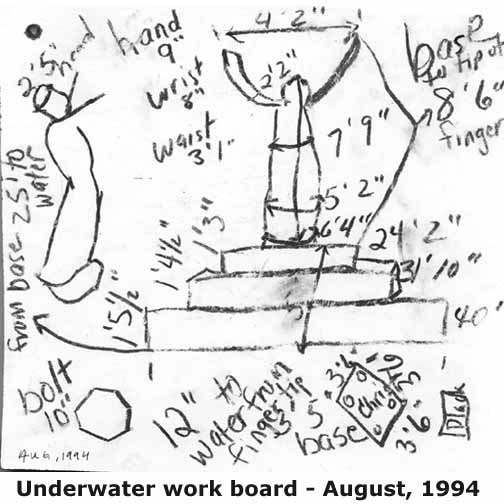
My underwater work-board with data. Many measurements were
taken
and recorded.
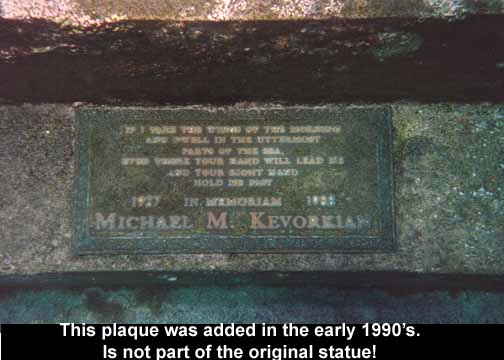
This plaque was attached decades after the dedication without
authorization and has recently (2007) fallen off. There is some
question whether Florida Keys National Marine Sanctuary will reattached
it as it was not part of the original sculpture. The plaque read:
"If I take the wings of the morning
And swell in the uttermost
parts of the sea,
Even there your hand will lead me
and your right hand hold me fast.
1927 In
memoriam 1988
Michael M. Kevorkian"
Michael Kevorkian was a Miami dive shop operator who operated dive
tours out of Key Largo. The story is that later dive operator Spencer
Slate had the plaque made and attached to the statue's base in the
1990s.
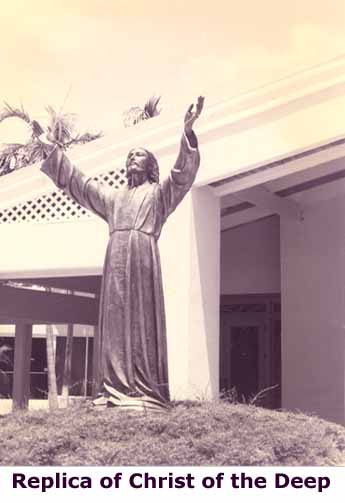
For Keys visitors, the St. Justins Martyr Catholic Church
provided
a way for non-diving people to see the statue. They commissioned Ido
Demetz
of Italy to make a bronze replica which was set in place in 1991. It is
located in front of the main sanctuary on US 1 at mile marker 105.5.

*Note: This
and the following three pictures are of F. Rambelli, courtesy of the
Historical Diving Society Italia.
The story is not over. In 1993 the original clay positive was found
under a shed at the casting foundry. Note the arms are missing.
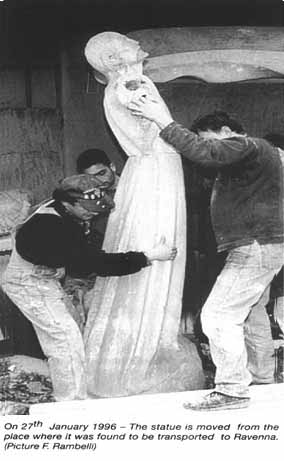
The clay mold was moved for restoration at Ravenna, Italy.
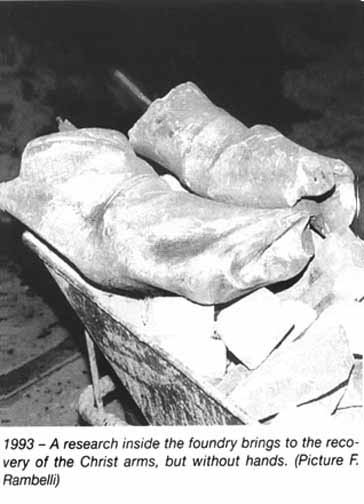
Upon searching the foundry, the arms were found in a box.
Note the
pins and holes to plug in the arms and hands. Please note that the
hands were not found
but rebuilt by the sculptor Mauro Bartolotti so the statue was complete.
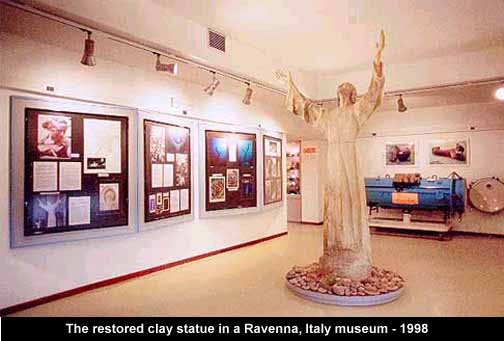
The complete statue can be seen at the Ravenna "National
Museum of the Underwater Activities".
See www.hdsitalia.com.
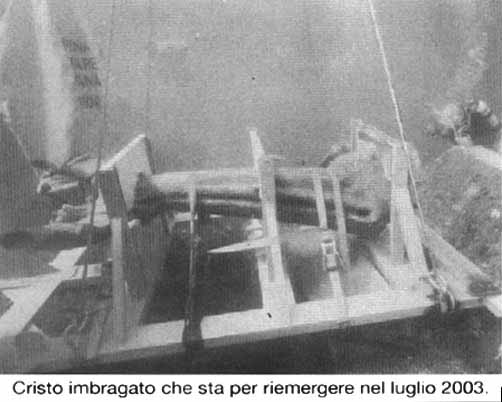
The story is still not over. Several years ago it was noticed
that
the original Christ of the Abyss near Genoa had one of its hands
severed.
Conjecture has it that probably an errant anchor was the culprit. Above
is depicted the statue being raised for restoration.

The bronze statue is shown be carefully restored at Genoa. For
those
inclined to believe, note how the stump has healed over. A replaced
hand
will be welded on and the good as ever Christ of the Abyss will be
lowered
again sometime in 2004.