| HISTORY
OF by Jerry Wilkinson |
 |
| HISTORY
OF by Jerry Wilkinson |
|
|
Neighboring Pigeon Key, Cayo Paloma on Spanish charts, was a major
stepping-stone
for the railroad construction. Like Long Key, Marathon and Bahia Honda,
a major construction camp was built on Pigeon Key. It survived as the
Overseas
Road and Toll District base of operations. It is the only large
collection
of railroad buildings spanning these two eras that remains. See Pigeon
Key page.
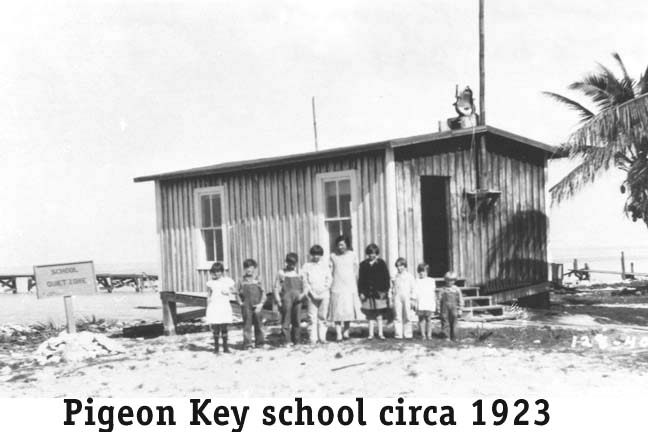
Marathon had a school as early as 1909, which was, as in the rest of the Keys, a one-room schoolhouse. Well known Upper Keys Charles "Prof" Albury taught school in Marathon in 1929 before moving to Matecumbe to teach with Ferran Pinder, and then to Tavernier after the 1935 hurricane. He retired in 1966 as the principal of Coral Shores High School. Marathon was not damaged significantly in the 1935 hurricane but there was a loss of life. From the Miami News dated September 6, 1935, "12 Dead Found at Marathon, Grassy Key By Rescue Craft - Six are dead at Marathon key, including Manager Lilja of the Thompson Fish Co. there, and six negroes are dead at Grassy Key. . . ." To read a government report of an inspection made on September 16, 1935, please Click HERE. Use the BACK ARROW to return here. Mrs. Sue Moore followed "Prof" as teacher, but moved to Big Pine Key after the 1935 hurricane. Monroe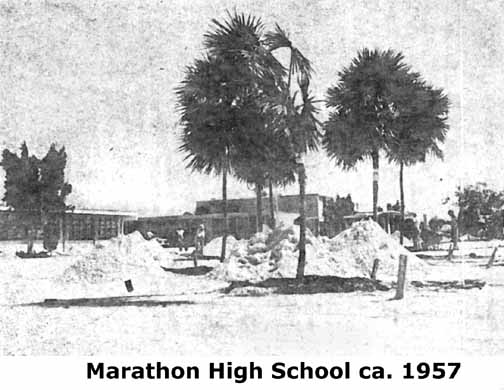 County's school newsletter "Tropic Topics"
states
that in 1938, Mrs. Sue Moore and Mr. Woodburn (the postmaster) of
Marathon
submitted a list of 15 students for a school at Marathon. One of the
buildings
owned by the Bridge District would be repaired and house the school.
The
School Board approved the proposal and requested that the Bridge
District
allow the school bus to pass through the tollgates without
charge.
When speaking of Marathon school history, one
must mention Mrs. Eva McKinney. When school opened in September, 1947
there
was no teacher. Mr. and Mrs. McKinney of New York City had purchased
land
in Marathon and hurried there to teach. She taught at the Sue Moore
School
for 18 years. Ground would not be broken for a high school until
October
5, 1956. The Marathon High School opened the following year with Gerald
Guthrie as principal. The high school PTA held its organizational
meeting
in May 1957 with Lillian Tingler nominated as president. County's school newsletter "Tropic Topics"
states
that in 1938, Mrs. Sue Moore and Mr. Woodburn (the postmaster) of
Marathon
submitted a list of 15 students for a school at Marathon. One of the
buildings
owned by the Bridge District would be repaired and house the school.
The
School Board approved the proposal and requested that the Bridge
District
allow the school bus to pass through the tollgates without
charge.
When speaking of Marathon school history, one
must mention Mrs. Eva McKinney. When school opened in September, 1947
there
was no teacher. Mr. and Mrs. McKinney of New York City had purchased
land
in Marathon and hurried there to teach. She taught at the Sue Moore
School
for 18 years. Ground would not be broken for a high school until
October
5, 1956. The Marathon High School opened the following year with Gerald
Guthrie as principal. The high school PTA held its organizational
meeting
in May 1957 with Lillian Tingler nominated as president.
- The largest Keys fish story took place in 1912 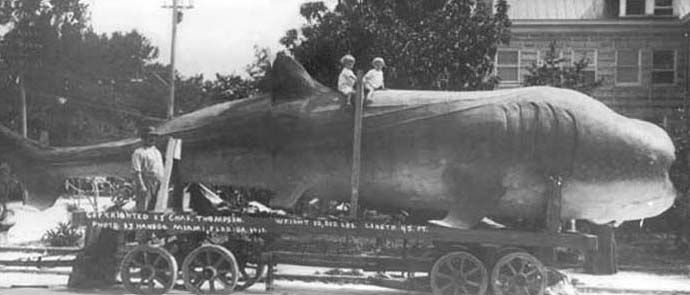 just
off of Knight's Key. Captain Charles Thompson of Miami harpooned a
38-foot-long
whale shark that reportedly took about 39 hours, five harpoons and more
than 100 bullets to subdue. The 26,594-pound whale shark was towed to
Miami,
preserved, stuffed and exhibited on a railroad flat car. The sign on
the
flat car read "weight 30,000 lbs. Length 45 ft." All went well until it
was accidentally destroyed by fire in 1922. just
off of Knight's Key. Captain Charles Thompson of Miami harpooned a
38-foot-long
whale shark that reportedly took about 39 hours, five harpoons and more
than 100 bullets to subdue. The 26,594-pound whale shark was towed to
Miami,
preserved, stuffed and exhibited on a railroad flat car. The sign on
the
flat car read "weight 30,000 lbs. Length 45 ft." All went well until it
was accidentally destroyed by fire in 1922.-
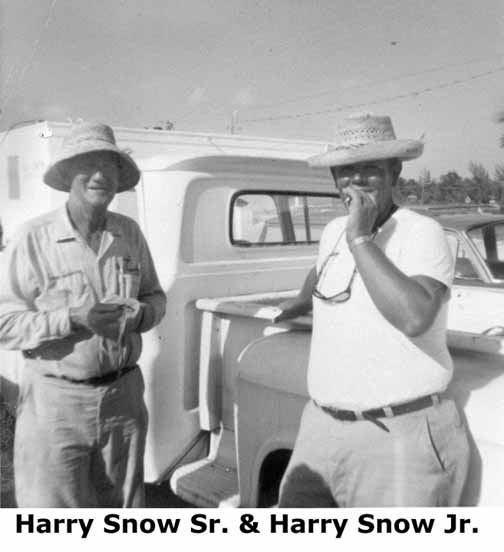
One of the first, if not the first, fishing guides in Marathon was
Captain
Harry Snow. Harry came from New York as a Fishing was and is an important part of Keys living. To see other early photos of the Marathon fishing industry Click HERE, then use the back arrow to return to this location. William and Mary Parrish moved to Marathon in 1927 with five daughters and one son to operate a fish house. Captain Snow married one of the daughters. The Parrish family watched the town grow as the first Overseas Highway with ferries went into operation. The family was instrumental in re-opening the school in 1928 by inviting a teacher, Miss Tessie Kyle, to live in their home. After the 1935 hurricane and the subsequent new highway opened, William Parrish became Marathon's first real estate broker. The highway also ushered in Greyhound Bus service (1938). One of the seldom mentioned, old time residents was Stephen C. Singleton. He homesteaded on Ramrod Key in the railroad days, sold real estate in the Upper Keys during the 'land boom', then managed the Key West Chamber of Commerce, but chose Marathon for his last days. In 1915 he wrote:
The Florida Keys
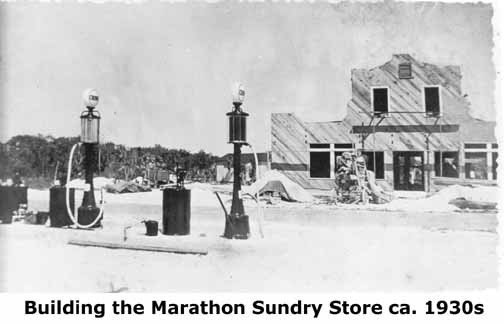
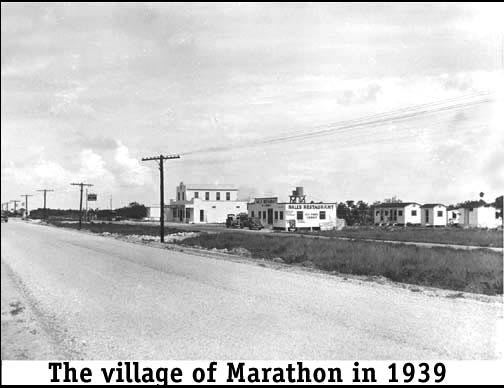
The 1930s brought change to Marathon and it was change that stayed. The
1909 post office had gone through a few postmasters. In September of
1929,
Arthur Woodburn took over as postmaster, a The advent of World War II brought electricity and fresh water to all the Keys, but Marathon also gained an airport and a Coast Guard facility. The Florida Keys Electric Cooperative Association, Inc. (FKECA) was certified by the Florida Secretary of State on January 22, 1940 with an office address of the "Marathon Grocery, Marathon, Florida." It had its first board meeting four days later and John A. Russell of Islamorada was elected chairperson. Of the incorporators, one was from Stock Island, two from Marathon, one from Islamorada, two from Tavernier and three from Rock Harbor.
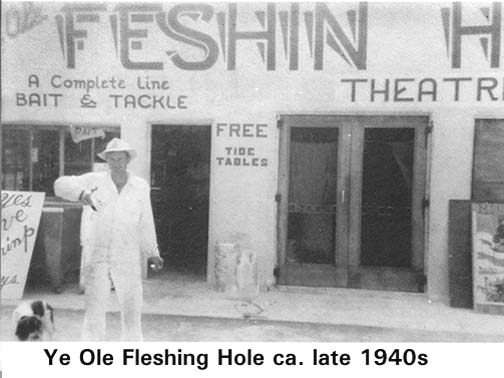
Electricity led the way for John and Wilma Brantner to open 'Ye Old
Feshing
Hole', first a bait and tackle shop, eventually The construction of the airfield brought another early family to Marathon. Thelma and Byron (Parky) Parkhurst had been following construction work on government war contracts in Florida and moved to Marathon in 1943 as a truck driver for the airfield contractor. When the job was over, Parky bought the truck for use in local jobs. He soon found work as manager of the Overseas Lodge. In 1945, he purchased a 38-foot Mathews boat and converted it (The Bon-Ami) for off-shore fishing. Thelma worked as his mate and in 1948 became one of the few female boat 'captains' in Florida. 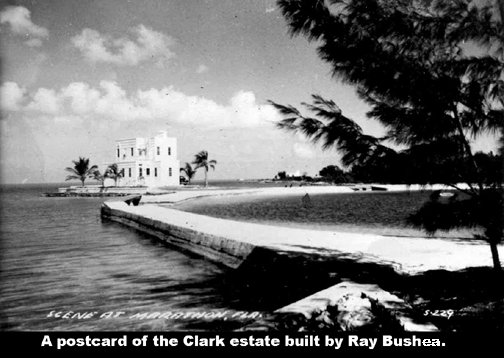 It was time for Marathon to have an estate, or mansion, which ever word you prefer. Masonary construction was used in the Keys before the later 'big hurricanes.' Two large concrete houses were built on Key Largo in the 1920s and another one on today's Fiesta Key for L.E. Goetz. At Marathon, Harold Clark had developed the Sombrero Hotel in the 1930s, which was later rebuilt as the Buccaneer Resort. In the 1940s, Ray Bushea built Mr. Clark a very large masonary house on Florida Bay as shown on a postcard at the right. Harold Clark was from Chicago and was the inventor of the oil seal. - - - - After the war was over, local business individuals and groups sought to make use of this obvious community asset. The first commercial airlines to offer scheduled air service was National Airlines in 1958. 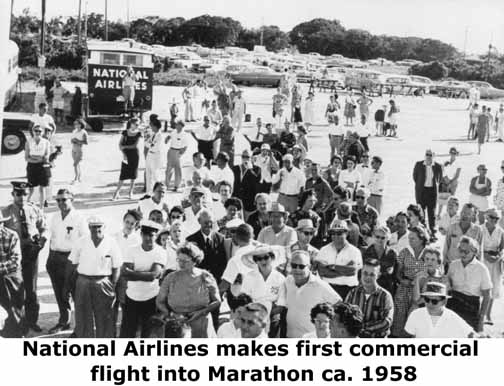 A
lighting system, rotating beacon and hard surfaced overlay were added
in
the 1960s. A parallel taxi strip was added in the 1970s. The facility
has
been completely modernized and is operated by the City of Marathon and
Monroe County who after much effort hope have a successful
scheduled air service. A
lighting system, rotating beacon and hard surfaced overlay were added
in
the 1960s. A parallel taxi strip was added in the 1970s. The facility
has
been completely modernized and is operated by the City of Marathon and
Monroe County who after much effort hope have a successful
scheduled air service.
Like the rest of the Florida Keys, Marathon realized changes after
World
War II. There are too many to list, but I believe the arrival of
Francis
and Mary Crane deserves listing. The story should be well known.
Simply,
they purchased the Norberg Thompson, Maitland Adams and George Adderly
land tracts. All in the 1950s, they built a house, a museum, gave land
for a church, developed a sub-division. What remains today are Crane
Point
and Crane Hammock as testimony to early minimal environmental impact
development. Although all the Keys participated in the 1950 "dredge and fill" mode, the author believes that Marathon led the the way. The Chamber of Commerce under J. J. Hall, president; Fred Center, vice-president; and board members William Parrish, Sr., Deane Brigham, Lewis Gray, George Goodson and E. G. Stempel plus about 200 members provided guidance.
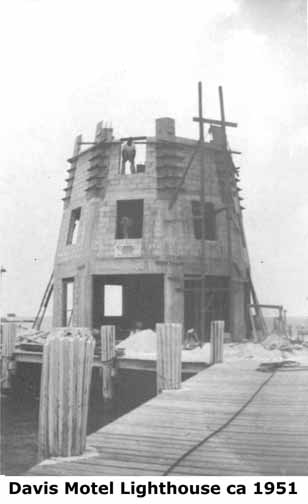
One of the 50s structures that remains began as the Davis Docks project
or the Marathon Motel and Docks. Floyd W. Davis had owned the property
where Miami International Airport was built
Another structure was the Marathon Theater, Marathon Self Storage. The
theater had seating for 450 customers, quite an ambitious project for
the
time. I opened for the showing of the "Battle Circus" on July 19, 1953
starring Humphrey Bogart and June Allyson.
In the
1950s, Phillip Sadowski and John Puto
probably double-handedly had made the largest change by developing
Marathon
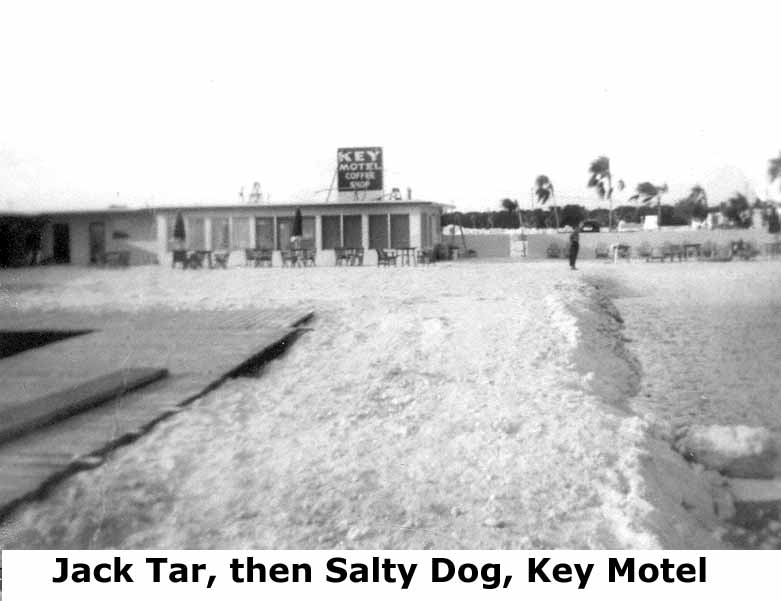
Shores and Little Venice areas. Their 125-unit air-conditioned Key
Hotel
changed ownership frequently. First the Jack Tar Motel, then the Salty
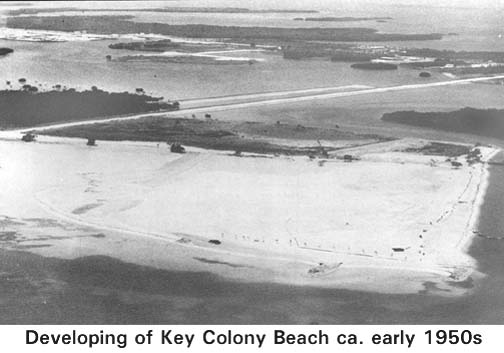
Dog Motel, the Driftwood Inn, etc. Almost at the same time, Shelter Key was developed into Key Colony Beach. Shelter Key was about 90 acres of mangrove in 1953 when Sadowski converted it to a 285 acre buildable island . With about 20 homes, the City of Key Colony incorporated in 1957, built a convention center (now the city hall) and has governed itself throughout these bureaucratic times. -
It could be slowed though as on September 11, 1960, Marathon took the
brunt
of Hurricane Donna. Winds up to 166 miles per hour
were reported. Parts
of an article titled "Hurricane Briefs" reported by the Keynoter
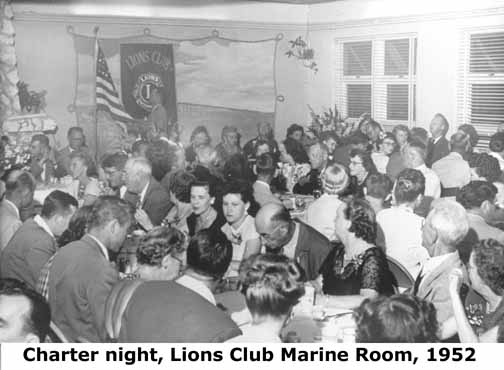
newspaper on Monday, threat when they opened Stout's Restaurant in 1964. And sure enough it was Hurricane Betsy in September 1965, but Marathon was spared massive destruction this time. Betsy was followed by Hurricane Inez in October of the next year, however only minimal damage was done. Newcomers began to worry with six hurricanes in six years. - - - - 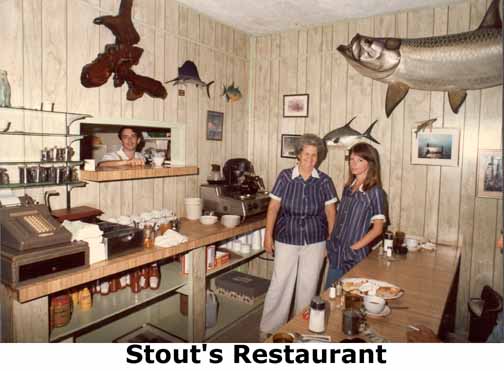 - - - - - - - - - To view miscellaneous photos of early Marathon service organizations and businesses, Click HERE.
As in much of the Keys, the 1970s were the "dredge and fill" era.
Marathon
began the decade by again declining to incorporate by 517 against and
115
for. The state designation of the Florida Keys as an Area of Critical
State
Concern in 1974 supplied the reins to be pulled on to control
development.
Government agencies began impact studies and environmentalists moved
in.
Most know the story from there on. Evolution occurred as in most
communities. The 1980s were a time of continued change for now not-so-small Marathon. Probably the significant event was the highway modernization. Construction of a new Seven Mile Bridge began in 1979 and opened May 24, 1982. The Vaca Cut Bridge was next opening for two-way traffic in March 1983. Controversy surrounded the four-laning 'in town'. It was done in five segments beginning in March 1985. The southwest portion was not done. The impacts and results of growth came home to rest in the 1990s. There were many who followed the likes of the Pents, Moores, Singletons, Smiths, Snows and Parrishs. They ran the proverbial 'marathon' well and produced today's great Middle Keys community, which has just voted to incorporate. What will 2000 and beyond bring? To go to or review
miscellaneous
photos of the Marathon area:
- |