| RELIGION
By Jerry Wilkinson |
 |
| RELIGION
By Jerry Wilkinson |
|
|
The desire or need for
some kind of religious worship appears to have
existed
from the beginning of the human race. The treks of the Spanish, French
and English to the New World were strongly influenced by religion, but
there appears to have not been any serious missionary efforts in the
Florida
Keys. Even Key West did not appear to have its first official church
ceremony
(Episcopal) until Christmas, 1832. This was four years after it was
incorporated
on January 8, 1828. To evaluate Florida's religious history is a bit presumptuous as most of its history is of the Native American with no written language. Should one attempt to do so anyway, the majority of it population can do so relative to the past 50 years and generally a much smaller span of time. The non-Floridian probably from the media thinks of Florida as a worldly society bordering on hedonism where pleasure or happiness is the driving motivation. However, in spite of the sunny climate, abundant water activities and comparatively scanty attire, religion has been a part of its written history since Ponce de Leon's arrival in 1513. All early pseudo conquistadors sailed and marched headlong into religious practices of Florida's Native Americans. In total population the permanent Native Americans outnumbered the white man well into early history. Since early Florida history is written by the white man, it is largely Catholic. Early on in the 1560s the French Huguenots threatened a foothold at the Jacksonville area, but the Spanish ended that effort. The English American Anglicans attempted another foothold from 1763 to 1783; however only in small numbers and the Catholics remained dominate. With the 1800s newcomers from neighboring states of Alabama, Georgia, Tennessee and the Carolinas, the evangelical and free-church groups soon outnumbered the Catholics. There was also the influx of Caribbean peoples mixed into the mixing pot. The 1830 and 1840 census summarizes Florida's early population: 1830 - white 19,400 - slave 16,100 1840 - white 29,400 - slave 26,100. Another perspective is from a census for the Florida Constitutional Convention in 1838: White Slave Free-Black Total Florida 452 93 73 618 Monroe County 25,132 21,132 958 48,223. -
KEY WEST -
Key West was, of course, the first permanent white settlement in the
Keys
and Indian Key was the second. I could find no record of an organized
church
movement on Indian Key, so I will proceed with Key West. This is not to
say that people did not gather in their homes to hold some kind of
religious service
-as they did later in the Upper Keys- until some permanent arrangement
could be made. Enough knowledge of Bahamian tradition would indicate
that
some form of worship took place without a formal physical structure, as
the church was in their hearts and not the edifice. A petition was made to the Protestant Episcopal Bishop of New York in 1831 for a permanent clergyman to be assigned to Key West. The Reverend Sanson Brunot arrived on December 23, 1832 -in time to conduct Christmas services. A coral-rock church building was completed for services in 1839 on a site donated by the widow of Mr. Fleeming (spelled Fleming today). In 1848, another frame building was built, with four pews in the rear reserved for black members. Bahamian Blacks held services from house to house. In 1875, they decided they wanted a place of their own with the name "St. Peters." The building was started in 1879. All costs were borne by the members and Black priest J. L. Kerr served for 15 years. By 1836, many of the new Key West settlers were Wesleyan Methodists from the Bahamas. They too worshipped from place to place and were under the leadership of Samuel Kemp. Using land donated by him, a small place of worship was constructed on Eaton Street near William Street. Because of the Bahamian influx into Key West, four Methodist church buildings were there by 1845. In 1868 the Methodists who wished instrumental music constructed the Sparks Chapel, but instrumental music was delayed until 1887 due to a deed restriction. In 1877, plans were adopted for a large coral rock building during the term of Rev. John C. Ley. The Baptists began meetings in Key West in 1842, but the absence of other Baptist churches in Florida prevented their affiliation with others. They, too, worshipped wherever they could find a place. Apparently, they (and others) used the courthouse as a place of worship. At one time, they even used the Episcopal and other church buildings. A permanent Baptist meeting place was obtained by 1849 and destroyed by fire in 1866. With the leadership of John White, it was replaced shortly thereafter where it remains today. Considering the early Spanish influence, a Catholic church would normally be expected to exist from the onset. This does not seem to be the case. The earliest records seem to be in the 1840s and the diocese of Savannah, Georgia only send priests to Key West once or twice a year to administer the sacraments to catholics. Key West's first Catholic church was established in 1852 with Father J. N. Brozard was appointed as the resident priest. The church building was destroyed by fire in 1901 and a new church made of concrete was dedicated in 1905. In the first decade of 1900, Key West had a population of about 17,000 and many other churches appeared. The First Congregational Church met wherever they could find space, which included a sail loft, until a permanent building could be built in 1903. In 1907, the Salvation Army built a tabernacle on Margaret Street. The Christian Scientist, followers of Mary Baker Eddy, also met in homes until they constructed a permanent building in 1911. The Jewish congregation, B'nai Zion, bought an existing building in 1907 and converted it into a synagogue. A new synagogue was built in 1969. -
UPPER KEYS -
Moving now to the Upper Keys, reportedly there were circuit riding
ministers who traveled the
Keys by boat/ship
giving services wherever there was a group. The ministers who
oversaw
multiple congregations were called 'circuit riders.' Circuit riders
began on horse back, morphed to horse and buggy, then to rail. Travel
in the Keys was by ship or on foot as there were a few foot paths
between
farms, but only then if they were close together. As the size and
number of pineapple farms increased, tram roads began to be made
between the fields and docks. Roads did not appear until the early
1900s when vehicles could be transported here via railroad. A bridge to
the
mainland was opened in 1928 and visiting ministers could drive down.The 1860 census shows a total 27 men, women and children in the Upper Keys - zero on Key Largo, Plantation and Windley Keys. After the Indian War crisis was over, the 1870 census indicated 134 inhabitants in the entire Upper Keys - Indian Key had 46, Matecumbe 14, Umbrella 4, Plantation 9 and Key Largo 61. The only minister listed was Robert J. McCook, a Methodist Minister on Indian Key, yet there is no mention of a congregation there. This Rev. McCook could have been the one by the same surname who fled Key West during the Civil War when assembly on Sundays was denied. He was chased out by the Union forces for having an unlawful assembly. All indications are he was the same McCook that was no Indian Key. No writings indicate that any religious activity was ever on Indian Key. The 1885 census indicated 429 people living on all Keys outside of Key West. Most of the 1890 census was burned and there is no census data for Monroe County. The 1900 census counted 450 living in the Upper Keys, but it is about to grow faster as the railroad became active. The Upper Keys had daily rail service after 1908. A note is that events occurring in the 1870s and 1800s were in the Reconstruction Period and organizations were in state of flux. Religions particularity had to modify activities base on race of the membership. The book "From Saddlebags To Satellites" by William E. Brooks, 1969 Methodist organization changes very well. Suggest pages 51 to 86. Now for some specifics which are scarce. The first account is that in 1881 two Methodist ministers - Somelian and Giddens - sailed from Key West to provide spiritual services in the Upper Keys. Research in 1994 with the United Methodist Church Florida Conference in 1994 could provide no information of this account other than stating that H.B. Somelian was appointed to the Cuba Mission at Key West, but could not find the name Giddens. The book 'Key West, The Old and the New' by Browne on page 42 does mention in 1886 a Rev. John A. Giddens was in Key West on account of ill health and was pastor of the Methodists worshiping in the Russell Hall school. Chapter 5 of his book is devoted to the Methodist Churches - Chapter 3 is Episcopal, chapter 4 is Catholic, chapter 6 is Baptist and other denominations. It is entirely possible that before 1886 Somelian and Giddens could have provided religious service individually or collectively to the Upper Keys citizens. Walter Maloney's book, a Sketch of the History - Key West - mentions none of these names. However, all writings use 1881 as the date that the Planter, which was not yet named Planter, and the Matecumbe Methodist churches began, A note in passing is that in the Upper Keys patented land titles could be obtained only by purchase before 1880 when land began to be homesteaded here with patent titles. Edward Bell became the first official land owner on Key Largo is 1876 when purchasing land due west of Carysfort Lighthouse where he was the lighthouse keeper. In 1880 Amos Lowe was the first homesteader obtaining all of the southeast end of Key Largo. Many homestead grants were awarded 1880. My point is there were few permanent people living on Key Largo in 1881 when Somelian and Giddens sailed to Key Largo. The second account passed on is that in 1887, the Florida Methodist Conference appointed Rev. J.M. Sweat to the Key Largo circuit as a "circuit rider" but by boat instead of a horse as the term was generally used. His circuit was to provide a week's service rotating first to Basin Hills on north Key Largo, then moving southward to Newport (middle Key Largo), then to Planter (southern Key Largo) and finally to Matecumbe, known today as Islamorada. Many, many homesteads were approved by 1887. Basin Hills: Little is known of the Basin Hills community and nothing of a meeting place. North Key Largo communities of the early 1880 settlers were known as Aiken, Whalton, Red Bird City, and Basin Hills - now part of John Pennekamp Coral Reef Park located along County Road 905 in route to Ocean Reef. This area was homesteaded and numerous vintage concrete/tabby water cisterns remain in the area; therefore, the area was inhabited at one time. Newport: As to a community of Newport, in 1886 Commodore Munroe of Coconut Grove wrote that he sailed the Egret to Newport on Key Largo and chartered the Newport to go to Key West to meet a steamer. Again, vintage water cisterns and an old beehive-shaped oven existed in the Newport area, now known as Hibiscus Park, MM 101.4. Concrete front stairs of a later meeting place remain, but it is not thought to be dated back to the 1800s. 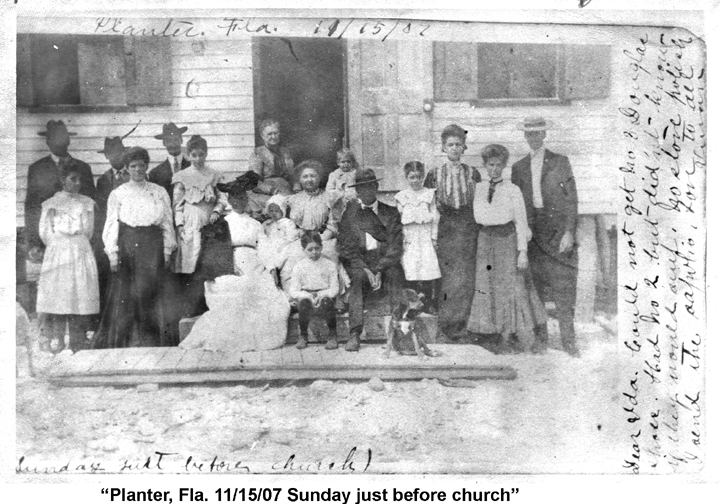 Planter: The southern end of Key Largo was Planter. The principal homesteaders were the Lowes, Alburys and Johnsons. I have the property transfer deed dated November 25, 1887 of a 71 by 185 foot lot and a building now being used as house of worship being transferred from Robert and Patience Albury to the the trustees of Methodist Episcopal Church, South. The names of the trustees in the deed were Amos Lowe, Samuel Johnson and Robert Albury, the heads of households of the above named homesteaders. Text in this notarized document show that the Methodist Episcopal Church South on 11/25/1887 was functioning, had elected trustees and the property had an existing house of worship on it named Barnetts Chapel. The witnesses were: J.M. Sweat and Silvanius Pinder. A note on the front of the envelop containing the deed is handwritten " Deed to the property on Barnetts Chapel." In Methodism, Barnett is the name of a long family of early Florida circuit riders beginning in Lake City, FL. In 1890, Monroe County created a school named "Johnson's Point" assumed to have been named after the owner of the 143 acre homestead of Samuel Johnson patented in 1882. A Planter post office was approved in December 1891 with Samuel's son, John Wesley Johnson, as postmaster. It was the only post office between Cutler and Key West. In 1892 the school's name was changed to 'Planter.' I believe it is a mistake to assume that the community of Planter was just the Johnson family homestead. The Lowes and Alburys were other large southern Key Largo families. The map to the right shows one in 1905, but current old timers say there was none in 1935. This could be true as the hurricane of 1909 caused serious structural damage in the Upper Keys. Note that both the school and the church were not on the Johnson homestead - in fact they were on the Albury homestead. The next written account that is passed on time and time again is at 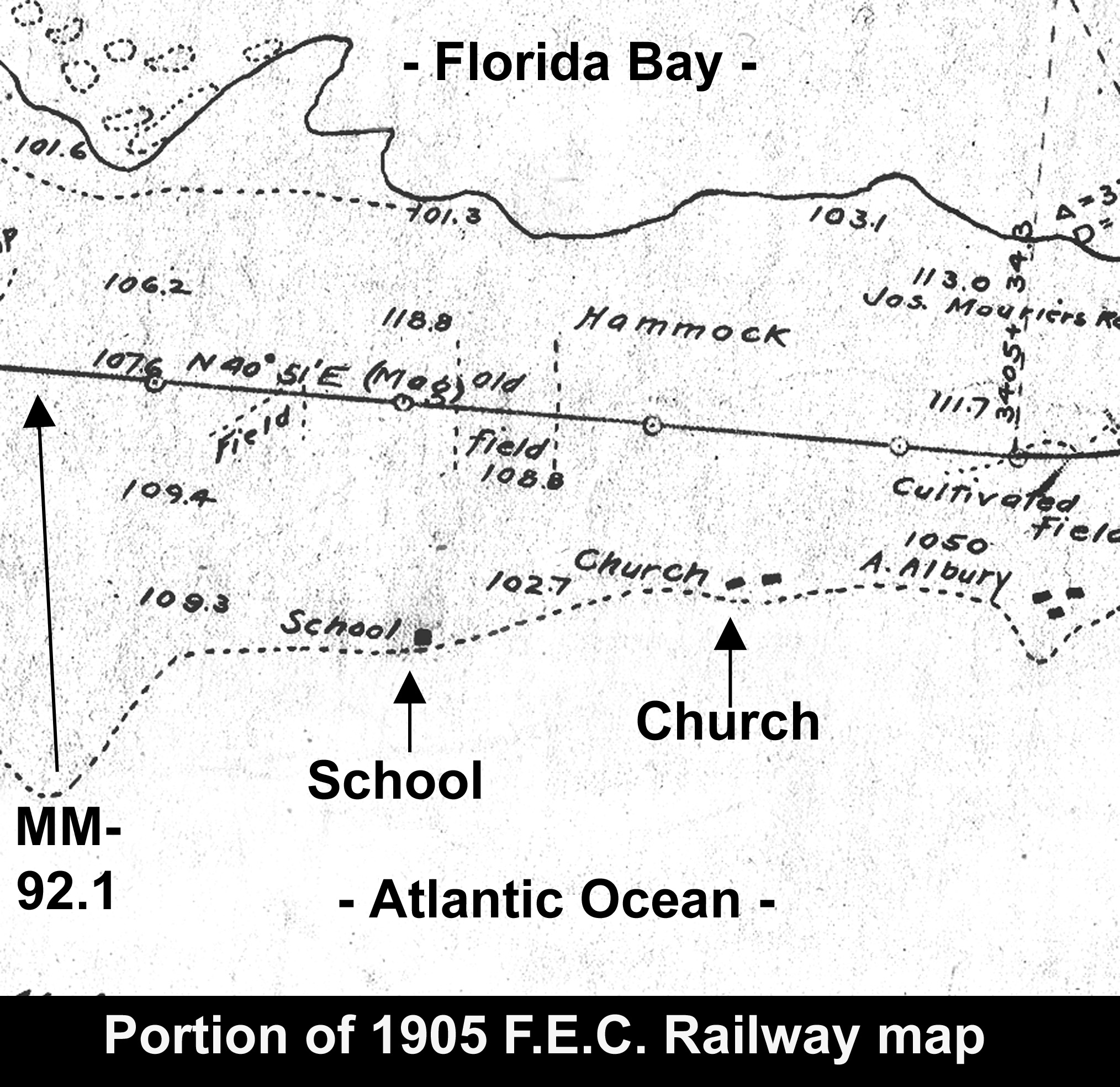 a
Methodist Episcopal, South, Tampa
District Conference held in
Arcadia,
Florida in 1891. The Reverend R. N. Evans of the Key Largo circuit
reported
that, "We have two churches, titles good and recorded. These churches
are
sound, painted and in very good shape. No encumbrances. Two new
churches
are needed. No parsonage." This and the
aforementioned Methodist circuit account
come from an article published in the Tequesta,
1970, number XXX, pages 64 through 68 by Reverend Jean U. Guerry. Note.
The Methodist Episcopal, aka M.E. Church, was the first manifestation
of 'Methodism' in the U.S. circa 1784 at Baltimore, MD. The 'Methodist
Episcopal, South' was organized is 1844 because of the slavery
controversy. a
Methodist Episcopal, South, Tampa
District Conference held in
Arcadia,
Florida in 1891. The Reverend R. N. Evans of the Key Largo circuit
reported
that, "We have two churches, titles good and recorded. These churches
are
sound, painted and in very good shape. No encumbrances. Two new
churches
are needed. No parsonage." This and the
aforementioned Methodist circuit account
come from an article published in the Tequesta,
1970, number XXX, pages 64 through 68 by Reverend Jean U. Guerry. Note.
The Methodist Episcopal, aka M.E. Church, was the first manifestation
of 'Methodism' in the U.S. circa 1784 at Baltimore, MD. The 'Methodist
Episcopal, South' was organized is 1844 because of the slavery
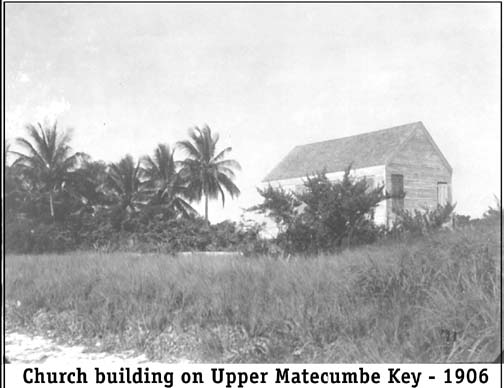
controversy.At the right is a portion of the 1905 approved right-of-way map for the construction of the railroad. I have marked the school and church sites. The post office was to the right of the this map and the creek to its left. The "A. Albury" house is that of Absolum Albury. This portion of the island was homesteaded by Joseph Albury. Matecumbe: Now we move further southward to Upper Matecumbe Key. Matecumbe Methodism probably spiritually was recognized by the same circuit rider Rev. J.M. Sweat who served the other Upper Keys communities - official names are another matter. In 1894, with the influence of Richard Pinder, a one-room wooden Methodist church was built on the beach some where on eastern Upper Matecumbe Key - see the photo at the top of this page. Richard's son, Preston, directed the construction and remained active in the church for fifty plus years. This church building was constructed on the upper end of Matecumbe to serve the Russell and Pinder pioneer families. See photo at the beginning of this article. Worshipers from Umbrella (Windley) Key most likely would have attended there. Those from Long Island (Plantation Key) could have went there or up to Planter. This Upper Matecumbe wooden building was moved farther south in about 1897 to accommodate the Parker family who had moved to the southern part of Upper Matecumbe circa 1894. The church was floated between two sailboats likened to the Ark of the Covenant in Biblical times. It was unloaded and moved to rest on the shore near the present-day Cheeca Lodge. Later, William Matheson donated the property for the school, church and cemetery to be next to each other. Etta Dolores Pinder was the first to be buried in the new cemetery. The older cemetery farther north is known as the Russell cemetery. The Russells were the first homesteaders on Upper Matecumbe. "Uncle Johnny," the Reverend John Watkins of Key West, was the first pastor. They celebrated their centennial on April 23, 1994 at their present location in Islamorada verifying 1894 as their beginning. There is subtle mention of a Methodist Church on Plantation Key in 1899 and the Rock Harbor Methodist Church organizing the same year and their association with the existing Tavernier (Planter) church. The Reverend John Watkins was also the pastor of the Plantation Key group. The coming of the railroad was a major historical/sociological turning point for the Keys. For the Upper Keys this was 1908. Ministers could travel more easily by train on Sundays and lay persons would fill in during their absence. The next turning point will be the 1950s. While covering the railroad construction, the Florida Times-Union reported on August 20, 1908: "The Rev. Edward F. Ley, presiding elder of the East Coast district of the Methodist Church, is on the Florida Keys holding quarterly meetings in connection with the Key Largo charge, Rev. J. D. Frierson, the pastor. Excellent and gratifying reports are made along church lines and the property of the people socially and financially. It is hoped that the good people will soon assist the church in the erection of a new church building on Key Largo and also on Matecumbe." The 1909 hurricane played havoc with the Basin Hills, Newport and Planter churches on Key Largo. Evidently Basin Hills faded after the 1906 hurricane as a May 1908 Key West Citizen article states that the Rev. J.D. Frierson was appointed to the Keys and held services on the first and second Sundays at Newport in Key Largo, at Planter (now Tavernier) every third Sunday and Matecumbe (now Islamorada) every fourth Sunday. The 1909 and 1910 hurricanes caused further damage but the opening of daily train service in early 1908 had a significant social influence on Upper Keys citizens. Residents along the Planter ocean front moved inland closer to the railroad which could and did make changes such as daily mail service along with ice and any other high use staple. The railroad depot was named Tavernier followed by a post office of the same name and the the need for sail boat services declined. One undated and unsigned document states the Basin Hills/Newport groups 'were merged into a new Church at Rock Harbor.' This same document states: "In 1899 folks on Plantation Key decided to build a Church. This was accomplished under the able and sincere leadership of Reverend John Watkins, lovingly known as 'Uncle Johnny.'" This probably was the same Uncle Johnny mentioned for Upper Matecumbe. The portion of the 1905 F.E.C. Railroad map for Plantation Key only shows a school. In Monroe County at that time for 'mini-schools' the citizens provided the school house at their expense; therefore, the building could serve a dual role. There is anecdotal information that the Flagler railroad which operated daily in the Upper Keys since 1908 could have provided a weekly minister at Rock Harbor from the Homestead area in early 1900. One of the later known ministers was the Reverend Getman of Florida City. A devout Rock Harbor Methodist named Beauregard Albury donated land to build the first Rock Harbor dedicated school building at about MM 98.5 in 1926. It was a twin of the coral rock school built at Matecumbe on the beach. After the Rock Harbor school consolidated with Tavernier in the 1937 WPA built hurricane/refuge school the Rock Harbor school building became the Getman Methodist Church. The building is now the stone portion of the Moose Lodge at about MM 98.5. Reynolds Cothron, who had come to the Keys to work for the railroad and his son, Alonzo, met Florence, the daughter of Benjamin Lee Pinder. They wanted to be married on Upper Matecumbe Key. The Reverend Munro was summoned from Key West and the marriage was on June 9, 1926. This was reportedly the first wedding ever performed at the little church on the beach. The marriage of Edwin Dennis and Leola Pinder was the second, followed by Berlin Felton and Mary Eloise Carey. The changes that the railroad brought translated into more people. The Keys were expanding -or shrinking if one thinks in another manner. The Methodist membership grew to over 100 Methodists, but the bell was about to sound for the last time on the beach of Matecumbe. Information is scarce in this period. I do have a December 16, 1926, Key Largo Breeze newspaper, published in Homestead stating: "Holds Service In Rock Harbor and Tavernier - Key Largoans Go To Hear Matecumbe Minister Preach - The Rev. J.L. Weissinger of Matecumbe conducted morning services Sunday at the home of Mr. and Mrs. William Albury in Tavernier and evening service in the school at Rock Harbor...." I interpret this that Tavernier in 1926 did not have a dedicated house of worship as when the area was called Planter." In speaking with Everett Albury, the grandson of William and Ada Albury, the Tavernier Methodists was still meeting there at the time of the 1935 hurricane. The Matecumbe Charge (Church) Reverend R. E. and Mrs. Carlson, who had only been assigned to Matecumbe for a few months, perished in the 1935 hurricane. The hurricane destroyed the Church at Matecumbe and its parsonage was swept off its foundations. Upper Matecumbe Key was as close to being completely destroyed by the 1935 hurricane as any place could be; however, they continued their faith. The church bell was found and suspended in a tree to announce the worship service. Reverends Harry Waller, A.A. Koestline, R.C. Homes and Jack Hager, presumably from the mainland, searched 10 days before finding Reverend Carlson's body wrapped in seaweed and covered by debris. Mrs. Carlson had been found earlier and both were taken to Groveland for burial. The parsonage was repairable and for a short time served as a small meeting place. Time, faith and a lot of hard work heals all wounds. Again under the leadership of Preston Pinder, a new wooden structure just north of today's Hurricane Memorial at mile marker 81.5 was soon ready for worship. Also on Upper Matecumbe Key, the Highway Gospel Hall, a Brethern Church, was built by Copeland Johnson shortly before the 1935 Hurricane. It was a small, but nice one room wooden building south of today's Green Turtle Inn. It faced the old highway on the west side and was just building up its membership when the hurricane struck. The building and Johnson perished in the hurricane.. On the island of Key Largo, the Rock Harbor school building where the church met on Sundays was not significantly damaged in 1935 and services continued without interruption. Before 1935, the Tavernier Methodist were meeting in the home of William and Ada Albury - something had happened to the Barnett Chapel building. After the 1935 Hurricane, the Tavernier Methodists built with donations and scrap lumber a meeting house on the lot of the modern day Masonic Lodge. In the interim, a McKenzie building across from the Tavernier Hotel was used under the direction of Reverend Yancy.  This wooden church was called The Tavernier Methodist
Church and was
used
for 23 years - see photo at the right. In 1956, the Reverend Scott
headed the ground breaking
for
the new Burton Methodist Church farther north at MM 93. The name
was in
honor of the Joseph Burton family who donated the land as well as the
land filling.
This wooden church was called The Tavernier Methodist
Church and was
used
for 23 years - see photo at the right. In 1956, the Reverend Scott
headed the ground breaking
for
the new Burton Methodist Church farther north at MM 93. The name
was in
honor of the Joseph Burton family who donated the land as well as the
land filling. After the Burton Methodist Church was completed, the Tavernier Masonic Lodge #336 purchased the old wooden structure in 1959 and used it until it constructed the present masonry constructed lodge building. To make room for the new lodge, the estimated date of the 1938 wooden structure was put up for sale. The community of Tavernier in the form of the Old Tavernier Town Association rallied together to purchase and move the building. It was first moved about 20 feet to allow construction to begin. In 1982, it was lifted off its foundation and moved by truck and trailer for temporary storage just north of Doug and Clara's Grocery awaiting approval of its final resting spot. Later it was moved and reassembled at its present location on U.S. 1 at about MM 91.7, now the office if the The Free Press newspaper. The only Upper Keys churches listed in the 1938 Redland District News citizens directory were the Matecumbe, Tavernier and Rock Harbor Methodist churches. The Reverent Floyd Bowery was listed as pastor of all three churches. -
Post World War II -
The Methodist church continued to dominate religion in the Upper Keys
until
the 1950s. Note: the period after WW-II brought all kinds of changes in
all walks of life and not just religion. The Middle Keys started the
Marathon Community Church in
1945.
Land was donated by Harold Clark and a permanent building established
in
December, 1949. The Catholic community began in the Upper Keys as a mission of the Homestead Sacred Heart Church. Msgr. John O'Dowd celebrated the first Upper Keys mass in the present Islamorada library on December 25, 1952. St. Augustine's Archbishop Hurley selected a 15-acre site at mile marker 89.5 for the San Pedro Parish in the Keys. The architect was Thomas Maddens Jr. and the builder William Stalcup. the bins at the main entrance are built from ballast stone from the wreck of the San Pedro with solid mahogany doors with sculptured panels by Richard Carrol. The communion bell was once used in a small Mexican Chapel and the tower bell was cast in 1917. Many of the lighting fixtures are copies of the famous Majano lanterns of Rome. According to my research it was dedicated in February 1955 as the Mission de San Pedro Roman Catholic Church recalling that the first churches in Florida were erected by Spanish Settlers. Presumably, Archbishop Joseph Hurley chose St. Peter as the mission's patron after the then recent discovery of the 1733 sunken Spanish ship San Pedro but most likely it honors St. Peter. The mission was designated a parish in 1959 with Father Luis Altonaga as the first local pastor. In the fall of 1953, a group of Lutheran families met in Tavernier in the home of Ben and Cris Bean. Later, in 1953, with Anthony Albury as chairman, they met with the Rev. Shepherd of the Homestead United Lutheran Church. Progress was slow, but with faith and determination they met in various locations. Services were held from 1956 to 1961 in the house built by Tavernier's first postmaster, Merlin Albury. Eventually, a permanent location was procured for the present Immanuel Lutheran Church on Plantation Key. It was dedicated on April 13, 1969. On January 4, 1954, the First Baptist Church of Islamorada was in its infancy when the Reverend John Whitt of Homestead began holding services in the present Islamorada library building. This was largely due to the efforts of Doris Albury and Elnora Woods who had organized a Sunday School in 1953. The Reverend Whitt resigned and Dr. Lacy took over. The Baptist Keys Mission was underway officially in April, 1954. With assistance from Homestead, Miami and the Florida Baptist Convention, a Key Largo/Islamorada church was organized. The Key Largo Baptists began meeting in the newly opened Key Largo Civic Club in 1955. Dr. Lacy became the pastor in August 1955. Land for a building was purchased in 1957 and the building completed in 1958. A second building was completed in 1959, a parsonage in 1960 and the present sanctuary in 1969. Additional help came when, in 1958, the Matecumbe Methodist Church constructed a new church building and donated the previous wooden building (complete with pews) to the Baptists. The Baptist Church of Homestead provided funds for foundations and moving. On May 11, 1958, they held their first services as the Islamorada Baptist Mission. Two years later, Hurricane Donna struck with some damage to most church buildings. For a few weeks services were held outdoors, in church annexes and some groups simply had to temporarily postpone meetings to recover. The Coral Isles Church was established in September, 1962 under the auspices of the United Church of Christ. Rev. William North became its pastor in 1963 and a sanctuary was built and dedicated on Plantation Key in 1966. Lois North went wooding hunting and with the assistace of the likes of contractor Alonzo Cothron and boat builder Willie Roberts she assembled four doors consisting of 40 sculptured panels of symbolism of many walks of Christian life. The early, black Bahamian Orthodox Church in Newport, where Father Joe Anderson was pastor, burned about 1958 - the whites were meeting at Tavernier by this time. His Joe Anderson's father was also a Bahamian Orthodox minister; therefore, little doubt there was an early Orthodox Bahamian church at Newport. We are not certain when it was built, but Edna (Davis) DeVoe recalls attending the son's church in 1942. This is a wooden building on the oceanside of the old highway in the area of the Monroe County housing authority HUD project at mile marker 101.4. Father Anderson also had a tin roofed lime/tomato packing house in which he permitted various religious groups to use. With the desegregation of Coral Shores School in the 1960s, the Burlington School for blacks was closed and the building subsequently used by the African Methodist Episcopalian Church. Meanwhile, the Church of Christ was meeting in various homes then the building that housed the Lions Club until Leroy Shade and Raymond Clark built the existing Church of Christ building at mile marker 101.3. The Island Community Church began as a living room bible study group in the home of Floyd Russell in the fall of 1968. Under the leadership of Bruce Porter the study group grew, incorporated and rented a small building across the highway from the present location. For special events they rented the Cinemorada Theater. Working together, the old movie theater was turned into the Island Community Church’s home. Classrooms were added and the Island Christian School was also born. St. James of the Fisherman began in 1959 as a group of Episcopalians meeting in the WPA built hurricane refuge/school, now the concrete portion of the Islamorada Library. The parish moved to its present location in 1970 using a pre-fab structure distinguished by a fishnet draping, driftwood cross and red doors. An office building was added in 1983 and the Children’s Center and Pre-School were established the following year. A parish hall with bell and tower were added in 1994. The Rev. Howarth Lewis, AIA, designed the new building replacing the original church and office building in 2001. In March 1964, Seventh-day Adventist Elder and Pastor of the Homestead Adventist Church, Don Wilkinson, drove to the home of Don Wollard on Lower Matecumbe Key to conduct bible study services on each Friday. Prior to hurricane Donna in 1960, they met at Islamorada civic building, now the Islamorada Library. Eventually an Adventist congregation was established at Marathon. The Tavernier and Matecumbe Methodists became United Methodist churches in 1968. In general, it is believed that a majority of burials were outside of the Upper Keys, or their grave sites have been destroyed. Other than the cremation sites for the 1935 hurricane, the Pinder and Russell cemeteries on Upper Matecumbe Key, and two engraved grave covers in Tavernier are all that remain. There are a few single headstones scattered about on other Keys. There are other fine groups, large and small, operating in the Upper Keys. Just because they are not listed here does not take away from their importance. The Historical Society maintains a file system and solicits information of all facets of local life. I encourage each organization to maintain a history of its group. Every group needs a historian just as it does a secretary and treasurer. The minutes are not usually sufficient for a comprehensive history. If not, fifty years from now, someone like me will research a paper and it will be as incomplete as this one, or based on oral history. Time moves on - and relatively fast! Return to General Keys History Index |